


STORIES WE THINK YOU'LL LIKE


2025 Microsoft Inclusion Changemaker Partner of the Year
Valorem Reply is proud to announce that we have been recognized as winner of 2025 Microsoft Inclusion Changemaker Partner of the Year Award
Read More
The Partner Program Development Model
Partner ecosystems have become one of the most important growth engines in the technology industry.
Cloud platforms, developer ecosystems, and global marketplace programs have expanded the role partners play in product adoption, customer success, and market reach.
But as partner ecosystems grow, many organizations discover something unexpected.
Scaling a partner program is often harder than launching one.
In the early stages of a program, partner operations are manageable. A smaller group of partners can be onboarded manually, co-marketing campaigns can be tracked with simple processes, and proof-of-execution submissions can be reviewed individually.
As ecosystems expand, however, operational complexity grows rapidly.
Partner onboarding requires coordination across multiple teams. Campaign reporting becomes difficult to track consistently. Incentive claims must be validated across hundreds or thousands of partner submissions.
Over time, partner leaders often find themselves managing a growing collection of tools, spreadsheets, and workflows that were never designed to support ecosystem scale.
At Valorem Reply, we have observed this pattern repeatedly while working with technology companies that operate large partner ecosystems. Programs that begin with strong partner strategies often struggle later—not because the strategy was flawed, but because the operational systems supporting the ecosystem did not evolve alongside the program.
To better understand this pattern, we outline a three-stage model for partner program development, which breaks ecosystem maturity into three stages:
- Strategy & Design
- Operational Foundations
- Governance & Growth
Each stage represents a different layer of ecosystem maturity, and each introduces new operational requirements as partner programs scale.
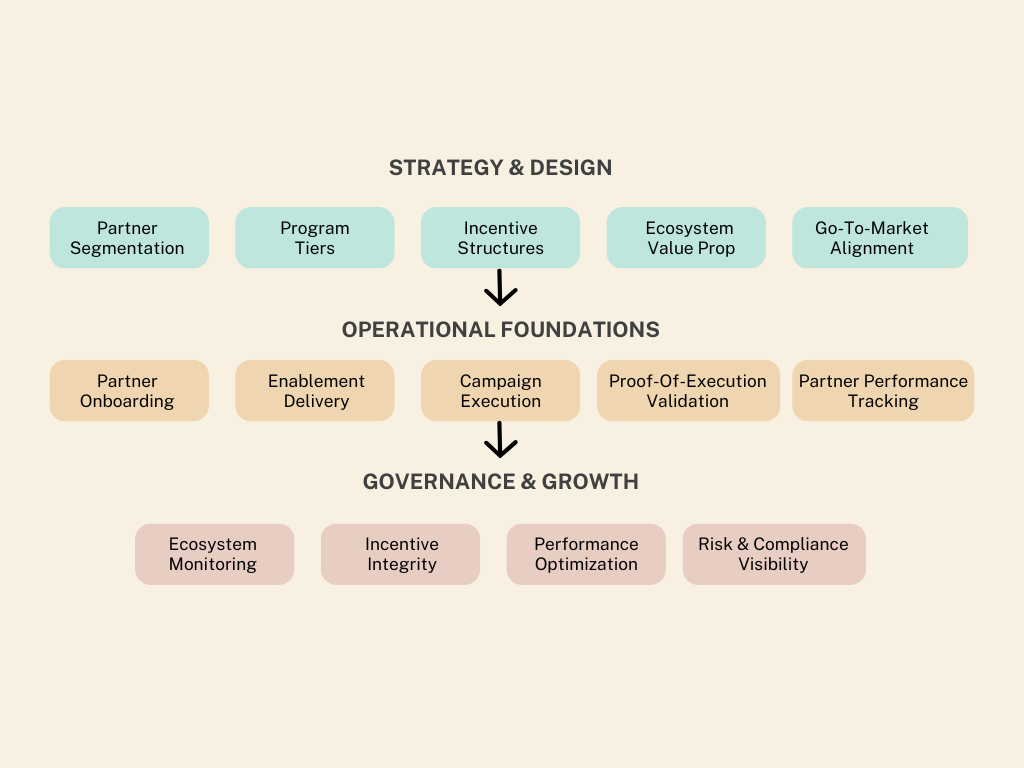
Modern partner ecosystems scale successfully when strategy, operations, and governance evolve together. When any of these layers lag behind the others, operational bottlenecks begin to appear.
Stage 1: Strategy & Design
Every successful partner ecosystem begins with a strong program design.
At this stage, organizations focus on defining the structure of the partner program and aligning it with product strategy and go-to-market priorities.
Key decisions typically include:
• Partner segmentation and partner types
• Program tiers and certification requirements
• Partner value propositions
• Incentive models and benefits
• Co-sell and marketplace strategies
These decisions determine how partners engage with the platform and how they generate value within the ecosystem.
However, program design alone does not determine long-term success.
Many organizations invest heavily in partner strategy but underestimate the operational systems required to support the program once it begins to scale.
Stage 2: Operational Foundations
Once a partner program begins attracting participants, operational infrastructure becomes critical.
Partners need to be onboarded quickly.
Enablement resources must be delivered consistently.
Marketing programs must be coordinated.
Partner activities must be tracked and validated.
This stage introduces the operational workflows that support ecosystem participation.
Typical operational capabilities include:
• Partner onboarding and certification workflows
• Partner portals and enablement infrastructure
• Co-marketing campaign execution
• Proof-of-execution validation
• Partner performance tracking
In smaller ecosystems, these workflows are often handled manually or supported by lightweight tools.
But as ecosystems expand, manual operations begin to create bottlenecks.
Partner submissions require manual review.
Campaign reporting becomes difficult to track.
Partner managers struggle to maintain visibility across hundreds or thousands of partners.
Organizations that want to scale their ecosystems successfully begin investing in automation and operational intelligence at this stage.
Signs Your Partner Ecosystem Has Entered the Operational Maturity Phase
Many partner leaders begin to experience operational friction once their ecosystem reaches a certain scale.
Common indicators include:
• Partner performance data is spread across multiple systems
• Proof-of-execution validation requires significant manual review
• Incentive reimbursement cycles take longer than partners expect
• Partner managers lack visibility into ecosystem activity
• Operational workload increases as the partner ecosystem grows
When these signals appear, it often means the partner program has outgrown its initial operational model.
Organizations that address these challenges early are better positioned to scale their ecosystems effectively.
Stage 3: Governance & Growth
As partner ecosystems mature, the primary challenge shifts from operations to governance.
Large ecosystems often manage significant financial investments through incentive programs, marketing development funds, and co-sell initiatives.
Without proper oversight, these programs can introduce financial risk and operational inefficiency.
Governance capabilities typically include:
• Ecosystem performance monitoring
• Incentive validation and compliance checks
• Anomaly detection and risk monitoring
• Partner program optimization using data insights
At this stage, the focus shifts toward ensuring that the partner ecosystem remains both scalable and financially sustainable.
Organizations begin using telemetry, analytics, and AI-driven insights to monitor partner activity and improve program performance.
Why Partner Programs Become Operationally Complex
Many partner ecosystems struggle because these three stages evolve independently.
Program strategy may evolve quickly while operational systems remain manual.
Operational tools may be introduced without a governance model to manage ecosystem risk.
Over time, this creates a partner program that becomes increasingly difficult to manage.
Common symptoms include:
• Fragmented partner data across multiple platforms
• Slow proof-of-execution validation processes
• Limited visibility into partner performance
• Difficulty identifying abnormal or suspicious activity
These issues rarely stem from partner strategy.
They are usually the result of operational systems that were never designed for ecosystem scale.
Building the Next Generation of Partner Ecosystem Operations
The next generation of partner platforms is focused on solving these operational challenges.
Rather than treating partner programs as isolated initiatives, organizations are beginning to manage them as integrated operational systems supported by:
• Centralized ecosystem intelligence
• Automated operational workflows
• AI-driven monitoring and analytics
These capabilities allow partner ecosystem leaders to focus less on administrative processes and more on ecosystem growth.
As partner ecosystems continue expanding across marketplaces, developer platforms, and global distribution networks, operational maturity will become a key differentiator.
The organizations that scale their ecosystems most successfully will be those that treat partner operations as a strategic capability—not just a program management task.
See How Organizations Gain Real-Time Ecosystem Visibility
Explore how ecosystem intelligence platforms help partner leaders unify partner data, track activation, and improve ecosystem performance. Learn more about Partner 360 today.
